GEOGRAPHY & LOCATION
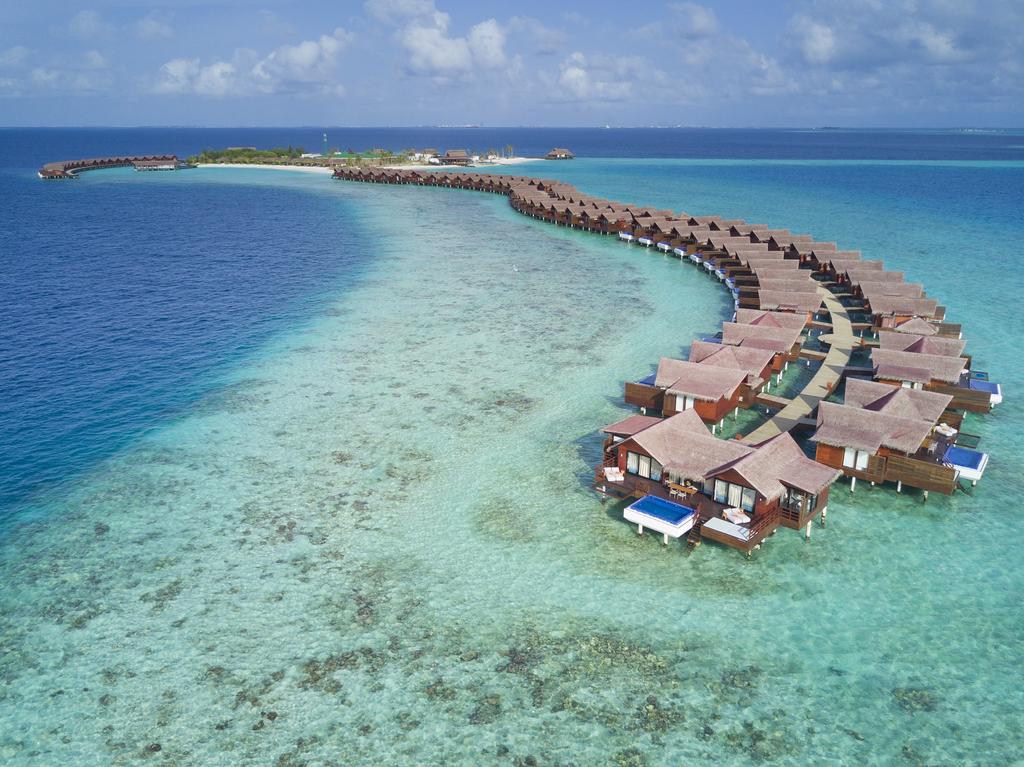
Republic of the Maldives is a sovereign archipelagic nation positioned in the Indian Ocean. Notably the South Asian Island nation has no counterpart in the entire world in terms of its unique geography and topography.
The Maldives comprises of 26 natural atolls consisting of dual island chains. Incidentally the Maldivian language has the distinct pleasure of contributing to the English word “atoll”, which was derived from the Maldivian word “atholhu”.
There are channels of various sizes between the atolls used for navigation. For efficient administrative functioning, the 26 natural atolls are categorised into 20 administrative divisions. Particularly the island nation is located in a strategic area with access to major international sea routes in the Indian Ocean.
The Maldives, located on top of a vast underwater mountain range have around 1190 islands and sandbanks. The pearl string like islands covers a land area of no less than 298 km2. All the islands are encircled by a lagoon blessed with crystal clear water. These islands are protected by a reef structure, housing one of the most exclusive and spectacular underwater life.
PEOPLE
Maldivians are esteemed around the World for their hospitality and affability towards their guests. Currently the population of the Maldives is 341,256. Additionally close to 60000 registered foreigners reside in the country.
Maldivians share a similar cultural heritage, history, ancestry, homeland, language and religion. These common factors are the reason for the unity and harmony prevailing in the alluring islands.
Maldivian ancestral roots can be traced back to Sinhala’s of Sri Lanka, Marathi’s and Guajarati’s of India, Arabs, Malays and Northern African dispositions. Accordingly, Maldivians emerged from a mixed race, which has enriched the culture and history of the country.
Presently Maldivians are adherents of the Sunni School of Islam. Maldivians embraced Islam in 1153 AD and since then the religion has played a key role in shaping the Maldivian society. Some of the famous landmarks in the country have been greatly influenced by Islamic architecture.
Before converting to Islam, the Maldivians were known to practice Buddhism and ancient paganism. Ancient Buddhist ruins are preserved in the country and antique Buddhist artefacts are displayed in the National Museum in Male’.
Traditionally whenever guests visit a local island, the islanders will welcome them by serving a fresh coconut drink. This tradition has continued to this day and do not be surprised if your resort offers a beautifully decorated coconut drink when you reach your destination!
CULTURE
The customs and social behavior of the Maldivians have been greatly influenced by the Indians, Sri Lankans, Arabs and North Africans who visited the Maldives while traversing through the trading routes of the central Indian Ocean. The Maldivian culture is rich and vibrant due to the infusion of various other cultural elements.
Though Maldives was culturally influenced by other traditions, Maldivians have built and preserved an exclusive cultural identity.
Accordingly the Maldivians converse using a language of their own; In 1153 AD Maldivians converted to Islam and the religion has transformed and introduced new fundamentals to the Maldivian culture.
Folklore Maldivians inherited a treasure trunk of ancient mythology and folklore that was passed orally through generations. These myths cover fascinating stories on various aspects of island life. Since the islands are surrounded by sea, most folktales depict fearful sea demons and spirits that haunt the islanders.
Life the island communities were very close-knit. This togetherness is still prevailing in the small island societies. Accordingly men will be mainly engaged in fishery, carpentry and toddy tapping. Women were mainly engaged in household duties and raising families. Certain rituals and practices were followed in the islands on special occasions like weddings. Some of these rituals survive to this day. The advent of tourism in the 1970’s accelerated the modernization process of the country. Today an increasing number of women hold crucial positions within the public and private sector. As a result of economic growth, dramatic lifestyle changes were introduced.
Music and Dance The Maldives boasts of a rich culture of music and dance. Some of the cultural music and dances can trace their roots to distant continents. Resort islands organize cultural performances to entertain their guests regularly during which you can observe islanders performing traditional music and dance items. One of the most famous Maldivian cultural displays which involve singing and dancing is called the “Bodu Beru”. The Bodu Beru performers, numbering around 20 will be wearing traditional garb of sarongs and white sleeved shirts. Bodu Beru performance is guaranteed to make you sway along with the drumbeats. Other traditional music and dance items include; Dhandi Jehun, Langiri, Thaara and Gaa Odi Lava. Most of these items involve rhythmic music and dances using various cultural props. There are some cultural routines exclusively performed by Maldivian women. Bandiyaa jehun, Maafathi Neshun and Bolimalaafath Neshun. Some of these acts were designed to perform in the royal courts. Indian and Western music have also greatly influenced the musicians of the country. Frequently resorts host performances of local bands to enliven their guests.
Craftsmanship Maldivians are known for being avid craftsmen. The intricate stone carvings found in the Friday Mosque in Male’ is a living example of Maldivian craftsmanship. The mastery and inventiveness of Maldivians can be seen in lacquer works, mat weaving, coir rope making and calligraphy. Traditional dresses and ornaments profess the artistry and creativeness of Maldivian artisans. Such exceptional works can be acquired by visitors as souvenirs. A visit to the Maldives not only guarantees the best vacation of your lifetime, but it also gives you exposure to a great cultural experience.
Top sights in Maldives
Old Friday Mosque

This is the oldest mosque in the country, dating from 1656. It’s a beautiful structure made from coral stone into which intricate decoration and Quranic script have been chiselled. Non-Muslims wishing to see inside are supposed to get permission from an official of the Ministry of Islamic Affairs. Most of the staff are officials of the ministry, however, and so if you are conservatively dressed and it’s outside prayer times, you may well get permission to enter on the spot.
Tickets & tours
Even though an ugly protective corrugated-iron sheet now covers the roof and some of the walls, this is still a fascinating place. The interior is superb and famed for its fine lacquer work and elaborate woodcarvings. One long panel, carved in the 13th century, commemorates the introduction of Islam to Maldives. The mosque was built on the foundations of an old temple that faced west towards the setting sun, not northwest towards Mecca. Consequently, the worshippers have to face the corner of the mosque when they pray – the striped carpet, laid at an angle, shows the correct direction.
Overlooking the mosque is the solid, round, blue-and-white tower of the munnaaru – the squat minaret. Though it looks a bit neglected rather than particularly old, this minaret dates from 1675. To one side of the mosque is a cemetery with many elaborately carved tombstones. Stones with rounded tops are for females, those with pointy tops are for males and those featuring gold-plated lettering are the graves of former sultans. The small buildings are family mausoleums and their stone walls are intricately carved. Respectably dressed non-Muslims are welcome to walk around the graveyard; you don’t require permission for this.
National Museum

Maldives’ National Museum may be a ferociously ugly building gifted by China, but it nevertheless contains a well-labelled collection of historic artefacts that serve to trace the unusual history of these isolated islands. Sadly the museum was broken into by a mob of religious extremists during protests against former president Nasheed in 2012, and its most precious items, some 30 ancient Buddhist coral stone carvings from the country’s pre-Islamic period, were destroyed for being ‘idols’. Security remains tight.
Tickets & tours
- Maldives 4-Night Tour with Male Airport Transportation$699
- Multi-day Snorkeling Tour in Local Island$820
- ADAARAN CLUB RANNALHI IN MALDIVES$162.84
The display begins downstairs with galleries devoted to the ancient and medieval periods of Maldivian history. Items on display include weaponry, religious paraphernalia and household wares as well as many impressively carved Arabic- and Thaana-engraved pieces of wood commemorating the conversion of Maldives to Islam in 1153.
Upstairs is a display representing the modern period and including some prized examples of the lacquer-work boxes for which Maldives is famous, and various pieces of antique technology including the country’s first gramophone, telephone and a massive computer. Quirkier relics include the minutes of the famous underwater cabinet meeting held under President Nasheed in 2009 and an impressive marine collection, the highlight of which is the 6m-long skeleton of the very rare Longman’s Beaked Whale, which is yet to have been sighted alive in the ocean.
Dhigurah
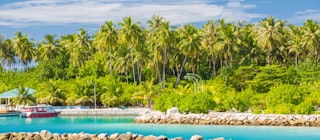
Image by icemanphotos Shutterstock
Dhigurah is a charming, clean and friendly local island with about 600 inhabitants and around ten guesthouses. It’s a very long island, with an absolutely stunning white-sand beach down one side that extends into a giant sandbank that sometimes connects Dhigurah to the LUX* Maldives resort to the south. There’s a bikini beach, several cafes and lots of souvenir shops along the main street. It’s a wonderful base for a diving and beach holiday.
Tickets & tours
- Male Walking Tour and Local Language Dhivehi Lesson$80
- 2- Tank Daily Boat Dive$134
- HALF DAY TRIP IN MALDIVES$65.13
Thulusdhoo
Island in North Male AtollSave Share

Image by Andrew Gunners Getty Images
Thulusdhoo has traditionally been an industrious island, known for manufacturing of bodu beru (big drums), for its salted-fish warehouse and for its Coca-Cola factory, the only one in the world where the drink is made from desalinated water. In the past few years tourism has exploded, however, and there are now some 30 guesthouses here, with plans for a further 20. There are several stretches of good beach, including a bikini beach and a bridge link to a small island.
Tickets & tours
- BIYADHOO ISLAND RESORT WITH ENTRANCE, SUNBEDS AND TRANSPORTATION IN MALDIVES$92.04
- Island Day Trip from Hulhumale$145
- BIYADHOO ISLAND RESORT ENTRANCE,SUNBEDS,BUFFET LUNCHSOFT DRINKS,TRANSPORTATION$110.4
Thulusdhoo is easy to reach from Male. There are regular speedboats (US$30, 30 minutes) from Male’s Fishing Harbour and Velana International Airport; see Atoll Transfer for details. Otherwise you can take public ferry 308 from Male’s New Harbour daily except Monday and Friday at 2.30pm, arriving in Thulusdhoo at 4.45pm.
China-Maldives Friendship Bridge
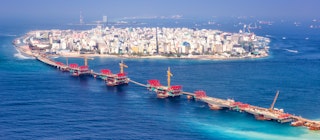
Image by Markus Mainka Shutterstock
This incredibly impressive piece of engineering connects Male to the airport island of Hulhule, but unlike most of the causeways connecting islands elsewhere in the country, this US$250m project goes over the open sea, meaning that vast concrete supports have been planted in the seabed. The bridge was still not operational at the time of writing, and it wasn’t yet clear how its opening would affect ferry services to/from Male from Hulhule.
Tickets & tours
- Vaali Beach Lodge Maldives$132
- Maldives Submarine 2-Hour Tour From Male$85
- MALDIVES SUBMARINE TOUR$150
Local opinion is divided about the bridge. While some argue that connecting the capital to its airport is an important infrastructural addition to Male, many people see the project as a huge waste of money and maintain that taking a ferry across the lagoon will always be faster and preferable.
Himmafushi
Island in North Male AtollSave Share
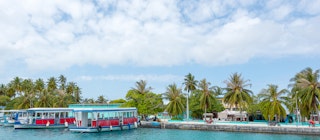
Image by Nick Brundle Getty Images
Himmafushi is famous for its main street selling some of the least expensive souvenirs in the country, such as carved rosewood manta rays, sharks and dolphins. Wander into the back streets and you’ll discover a sleepily traditional village and a cemetery with coral headstones. A sand spit has joined Himmafushi to the once separate island of Gaamaadhoo, where there used to be a prison. The surf break here, aptly called Jailbreaks, is a great righthander.
Tickets & tours
- Best surfing at Hikkaduwa$67
- HALF DAY TRIP IN MALDIVES$65.13
- Malé Half-Day Walking Tour$40

 Travel